Imagine the odds. You're deep in the mines of Stardew Valley, your pack heavy with hard-earned Magma Geodes. You head over to Clint's shop, anticipation buzzing as you prepare to crack them open. What treasures await? Iridium ore for those precious tool upgrades? A rare and beautiful gem? Now, imagine your disbelief as, one after another, the same dark, unassuming mineral tumbles out. Not once, not twice, but six consecutive times. This wasn't a dream or a modded game—this was the jaw-dropping reality for one Reddit user, Vegetable_Line9078, who stumbled upon an old replay showcasing this statistical nightmare. While winning the lottery might feel more probable, this player's 'prize' was a half-dozen Neptunites, making them a strong contender for one of the most unfortunate farmers in Pelican Town history.
How could such a bizarre sequence of events even occur? To understand the sheer scale of this improbability, one must first understand the mechanics of geodes in Stardew Valley. When you open a geode, you're rolling the dice on a vast table of possible outcomes. While common resources like stone, clay, and coal are frequent finds, the true excitement lies in the chance for minerals and, crucially, Iridium Ore. Both Omni Geodes and Magma Geodes hold that coveted 5% chance to yield Iridium, the key to unlocking the game's best tools.
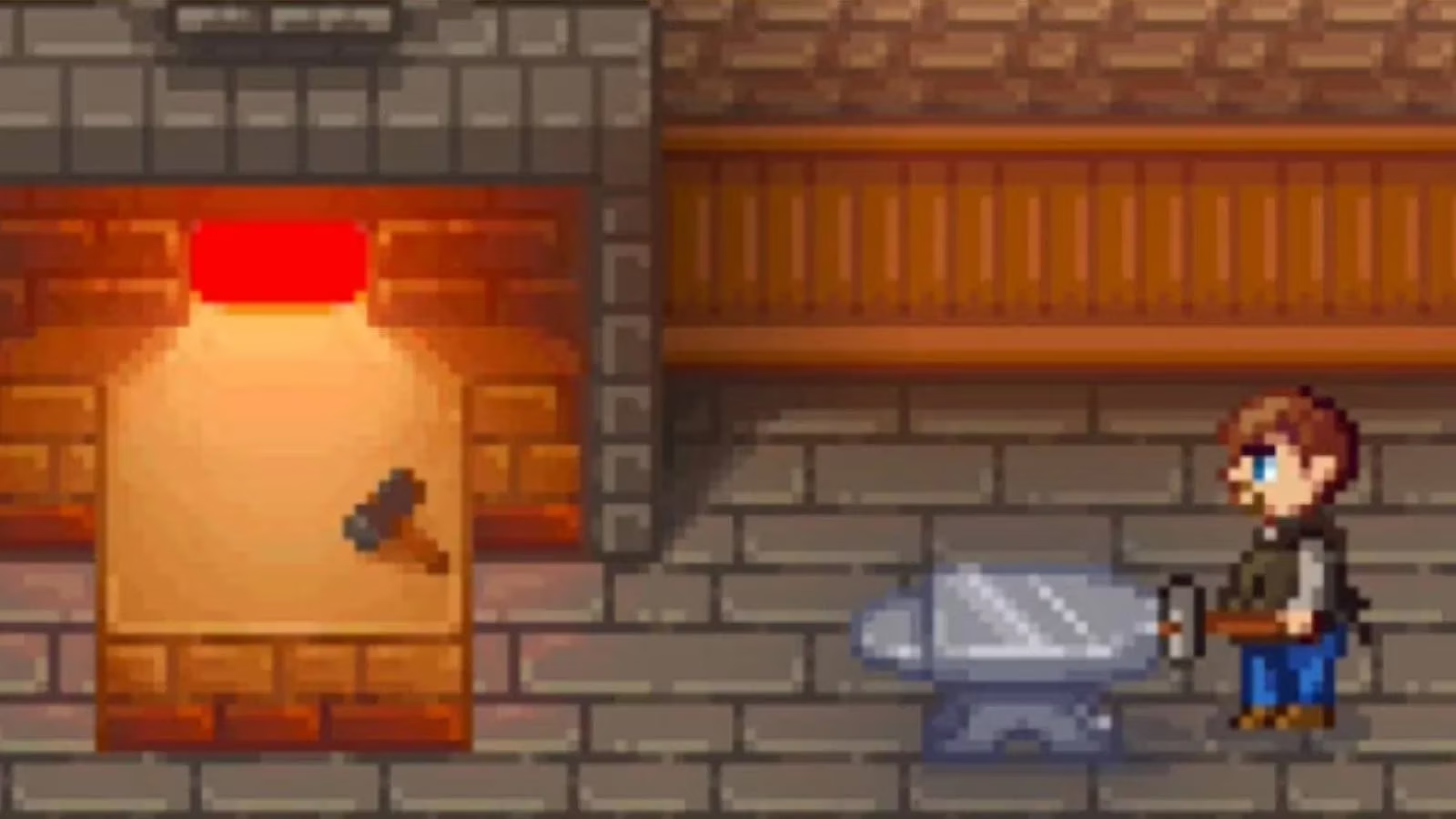
Focusing on Magma Geodes specifically, the chance of getting any mineral from one is already a slim one in twenty-six. The game's loot tables are designed to be random and independent; getting a Neptunite from one geode doesn't make the next geode any more or less likely to contain another. It's a fresh roll of the dice every single time. So, what are the odds of rolling the same specific outcome on that one-in-tw-six chance six times in a row? The math is staggering. It's (1/26)^6, a probability so infinitesimally small it borders on the impossible. One might reasonably ask: was this just the universe playing a cruel joke, or was something else at play?
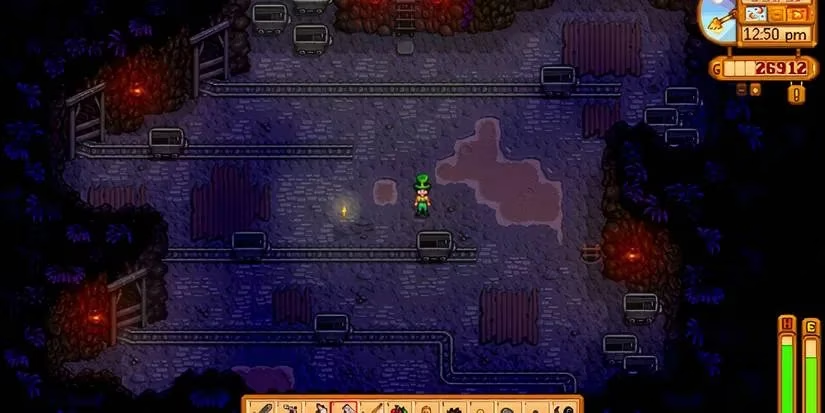
Let's talk about the 'prize' itself: Neptunite. Of all the minerals to get six times, why did it have to be this one? The Magma Geode mineral pool is diverse, containing twelve possibilities. Here's a quick look at what else was on the table that fateful day:
| Mineral | Icon |
|---|---|
| Baryte |  |
| Basalt |  |
| Bixite |  |
| Dolomite |  |
| Fire Opal |  |
| Helvite |  |
| Jasper |  |
| Lemon Stone |  |
| Neptunite |  |
| Obsidian |  |
| Star Shards |  |
| Tigerseye |  |
Neptunite, unfortunately, sits near the bottom of the usefulness ladder. Its uses are incredibly niche—primarily as a gift for a couple of villagers or as a source of black dye in the Sewing Machine. Its selling price is mediocre. So, not only did this player hit a one-in-a-billion statistical anomaly, but the subject of that anomaly was arguably the least exciting mineral in the batch. Talk about adding insult to injury!
Given the astronomical odds, the community quickly theorized a more plausible explanation than pure, unfiltered luck (or rather, unluck): a bug. The clip, though shared recently, was recorded some time ago. During that period, there was a known glitch on the Nintendo Switch version related to Magma Geode randomization. This bug could cause the game's random number generator to get 'stuck' on a particular output, leading to repeated identical results. Isn't it just the worst feeling? Spending hours battling monsters in the scorching depths of the Volcano Dungeon, only to have your precious geodes succumb to a software malfunction. It turns a moment of thrilling discovery into one of profound frustration.
Yet, the story captivates us precisely because it lives in that grey area between a documented glitch and a mathematical miracle. Part of the enduring magic of Stardew Valley is its massive, active community. Even in 2026, years after its initial release, the game boasts a dedicated player base. With tens of thousands of farmers tending their plots, fishing, and mining every month, the law of truly large numbers suggests that even the most improbable events will eventually happen to someone. This Reddit user's six Neptunites stand as a testament to that. It's a shared moment of communal head-shaking and sympathy—a reminder that in a game built on chance and routine, sometimes the universe decides to write a uniquely strange, and slightly disappointing, story.
So, the next time you hand a bundle of geodes to Clint, remember the tale of Vegetable_Line9078. Will you be the one to find that elusive Iridium? Or will you, against all conceivable odds, become the next farmer buried under a mountain of identical, mildly useful rocks? Only the random number generator—and perhaps a now-patched Switch bug—knows for sure. 🪨🪨🪨🪨🪨🪨
Data referenced from Digital Foundry helps contextualize why players sometimes suspect a technical hiccup rather than pure randomness when an extreme streak occurs, since platform-specific performance quirks, version differences, and edge-case bugs can meaningfully shape what a player experiences—even in systems intended to behave like independent “rolls” such as loot tables.