It's not every day that a video game waltzes into a classroom and starts draining imaginary tokens from a fictional farmer, but that's exactly what happened when a Stardew Valley-themed math problem made its way onto a student's desk. The assignment, shared by Reddit user OblizPurple in early 2025, featured a certain Mr. Smith who apparently thought playing the spinning wheel at the Stardew Valley Fair was a solid retirement plan. Spoiler alert: it wasn't.
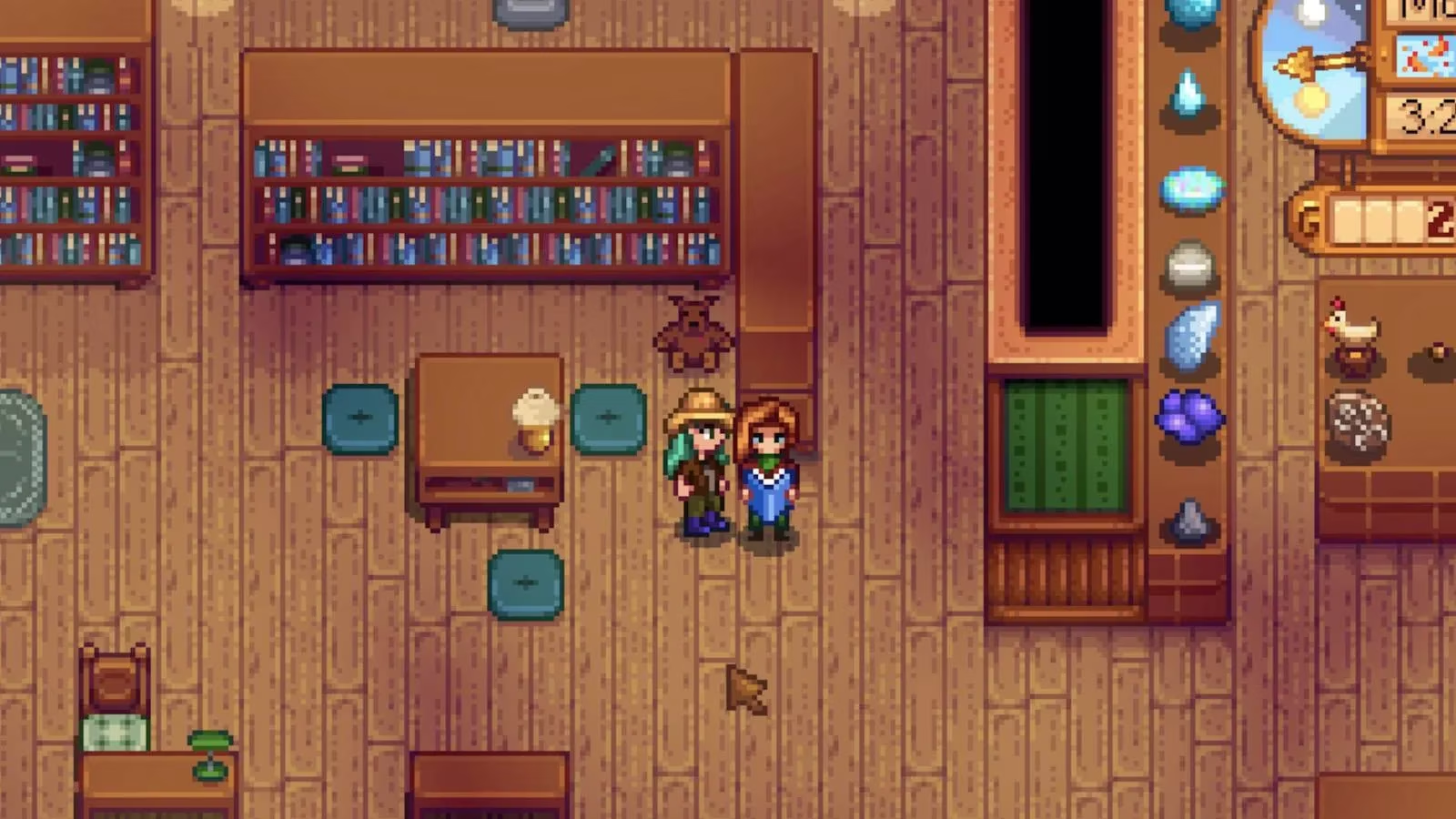
The problem, as wholesome as a fresh parsnip, imagined Mr. Smith strolling up to that brightly colored wheel of chance and placing a series of bets. Over five games, the poor soul gained 200 tokens, then lost 500, won 300, dropped another 400, and finally scraped back 100. Do the math—literally, that's the point—and Mr. Smith ended up 300 tokens in the hole. For a teacher to dream up such a scenario, they must either be a secret Stardew veteran with a cruel sense of humor, or someone who really wants kids to understand negative integers. Probably both.
Responses from the Stardew Valley community were swift and merciless. One player remarked that Mr. Smith clearly shared their own cursed luck at the wheel. Another pointed out that if the man had simply placed every single bet on green, he would have walked away with a tidy profit. The spinning wheel mini-game, for those who haven't spent countless in-game hours in Pelican Town, is not a true 50/50 gamble. Thanks to how the game's code decides the outcome, betting on green gives roughly a 75% chance of victory. That means the optimal strategy is about as subtle as a bomb in the mines: always bet green. Orange is a siren call that leaves you broke and slightly embarrassed.
The conversation underneath the Reddit post veered into delightful tangents. Teachers who play Animal Crossing were name-dropped. Childhood memories of sneaking Game Boys under desks resurfaced. But the core sentiment was clear: Stardew Valley has become such a beloved cultural touchstone that it's now fair game for pedagogy. And honestly, if a math problem has to exist, it might as well involve spinning wheels and pixelated chickens.
What makes this especially delicious in 2026 is the timeline. Stardew Valley first planted its seeds in 2016. The kids who discovered it during those early harvests are now, as of this year, a full decade older. Many have graduated college, entered the workforce, and yes, some are standing at the front of classrooms with whiteboard markers and a deep understanding of keg optimization. This means the Mr. Smiths of the educational world are increasingly people who have spent years romancing Abigail, failing at Journey of the Prairie King, and cursing the traveling cart. Their homework problems come pre-aged in artisan oak casks of experience.
Beyond the laughs, this math cameo is part of a growing trend. Stardew Valley has appeared in textbooks before, usually as a cozy example of economics, probability, or sustainable farming metaphors. The game's absence of gore, its gentle pacing, and its massive intergenerational appeal make it a teacher's dream. A lesson on supply chains? Turn to Pierre's shop. Want to explain budgeting? Let's audit the farm's Starfruit wine empire. And if you need a lesson on probability and the gambler's fallacy, the Stardew Valley Fair wheel is right there, ready to fleece Mr. Smith of his hard-earned tokens and perhaps teach a child how negative numbers feel when they disappear from a digital wallet.
So what's the takeaway for both students and hypothetical Mr. Smiths?
🎡 Wheel Wisdom Table
| Bet Choice | Expected Outcome | Emotional State After 5 Spins |
|---|---|---|
| Impulse Orange | Bleak | Instant regret, questioning life choices |
| Steady Green | Sunny | Smug satisfaction, surplus tokens |
| Mr. Smith's Method | -300 tokens | Confusion, possible rage quit |
This table should probably be printed on classroom walls everywhere. It's not just math; it's a life lesson wrapped in 16-bit charm. Always bet on green, never doubt ConcernedApe's hidden favoritism, and if a teacher hands you a problem about a video game, know that you are experiencing peak education.
The most heartening part of the whole episode is that Stardew Valley's relevance refuses to wilt. Even in 2026, with its 10th anniversary being celebrated by players worldwide, the community remains as vibrant as a pumpkin soup after a long day of mining. Mods continue to flourish, multiplayer farms bring families together, and apparently, classroom whiteboards get a little greener. As long as teachers can turn a mini-game into a teachable moment, Mr. Smith's losses are society's gains.
One has to wonder: if the hypothetical problem ever gets a sequel, will Mr. Smith finally learn? Perhaps a follow-up question could involve the casino in Calico Desert, or the terrifying mathematics of Skull Cavern dives. Until then, let his 300-token tragedy serve as a cautionary tale. Math is hard, but the spinning wheel is harder—unless you just bet on green, you absolute haywire.