In the verdant, pixelated world of Stardew Valley, where seasons turn with the gentle rhythm of a farmer's heart and the community thrives on simple connections, a dissonant note persists amidst the symphony of pastoral life. For all its celebrated charm and the countless updates that have woven new threads into its tapestry, one aspect of the game remains a stubborn source of frustration for its devoted cultivators: the act of decorating a home. How can a world so lovingly crafted, where every crop and fish feels perfectly placed, falter when it comes to arranging a rug or centering a painting? The answer lies in a system of charming, yet often baffling, inconsistencies that players have learned to navigate with a mix of love and resignation.
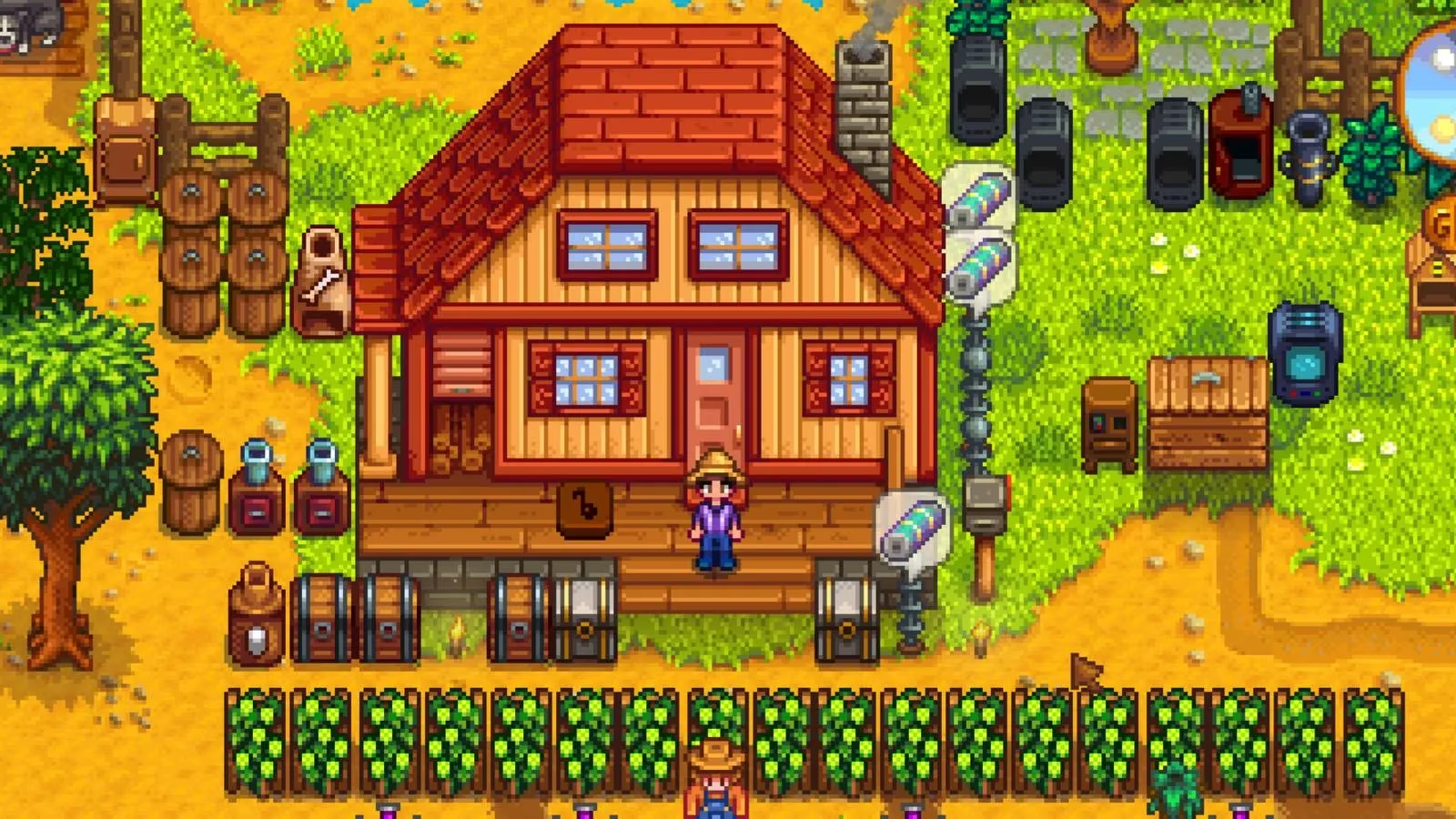
Consider the celestial furniture set, a poetic idea meant to bring the harmony of the heavens into a farmer's humble abode. Yet, as discovered by a keen-eyed player, this harmony is broken on the pixelated plane. The Sun table, in a quiet rebellion against symmetry, is larger than its lunar counterpart by a single, defiant row of pixels. Is this a cosmic joke, or merely an oversight lost in years of updates? While seemingly a minor flaw in a vast universe, this pixel-perfect imperfection symbolizes a deeper, long-standing grievance within the community. Players continue to appeal to the game's creator, ConcernedApe, with hopeful pleas to "please correct it," a testament to their desire for a world that is beautiful not just in its fields, but in its furnishings.
Why does this matter in a game about farming, fishing, and friendship? The act of creating a home is, for many, the final, personal expression of their journey in Pelican Town. It is the quiet culmination of their efforts. Yet, compared to the fluid, satisfying loops of planting crops or casting a line into the mountain lake, decorating can feel like a puzzle with missing pieces. As players have noted, the furniture catalog, though sizeable, often presents a dilemma: items are either aesthetically displeasing or exist as lonely orphans with no matching counterparts that align in the grid-based reality of the home. This has led to a curious phenomenon—the embrace of the "ugly farm." Rather than battle the clunky placement system and limited options, many farmers choose functional chaos over meticulous, frustrating design. Is a home not a reflection of the soul? In Stardew Valley, it seems the soul must sometimes compromise with the grid.
The community's ingenuity has, as always, blossomed in this digital soil. Modders have crafted solutions with remarkable precision, offering tools for pixel-perfect furniture placement or even expanding the town itself to offer new canvases for creativity. However, these are but patches on a beloved quilt. They cannot alter the fundamental weave of the base game's systems. There is a certain charm, perhaps, in working within these limitations—a challenge accepted by the most dedicated decorators. But does this challenge bring the same profound satisfaction as mastering the community center bundles or finally marrying a beloved villager? For many, the answer is a reluctant no. The decoration system, in stark contrast to the rest of the game's masterfully tuned gameplay, often falls flat.
| Stardew Valley's Gameplay | Decoration System Experience |
|---|---|
| Farming: Relaxing, rewarding progression | Furniture Placement: Often frustrating, grid-limited |
| Fishing: Skill-based, satisfying mini-game | Item Matching: Sparse sets, aesthetic mismatches |
| Socializing: Deep, narrative-driven relationships | Creative Expression: Hampered by technical quirks |
| Exploration: Mysterious and expansive | Home Customization: Can feel like an afterthought |
This legacy of decorative dissonance sets a fascinating stage for ConcernedApe's next venture, the eagerly anticipated Haunted Chocolatier. The creator has already hinted at a greater focus on combat and world exploration, a shift from Stardew's pastoral roots. Yet, consider the new game's core premise: running a bespoke chocolate shop. Here, decoration is not a side activity; it is central to the fantasy. The placement of a counter, the arrangement of a display case, the ambiance of the storefront—these elements are the gameplay. Would a poor placement system, with rugs that refuse to align and tables that vary by a pixel, be a charming quirk or a glaring flaw in a chocolatier's daily reality? The potential for a more precise, integral decoration system is not just an improvement; it feels like a necessity for the fantasy to thrive.
Thus, Haunted Chocolatier arrives not just as a new game, but as an opportunity—a chance to learn from the past. ConcernedApe has listened to his community before, refining and expanding Stardew Valley into the phenomenon it is today. The spiritual successor now carries the weight of those accumulated wishes. It has the perfect foundation to build another genre-defining experience, one that could seamlessly blend the heartfelt warmth of its predecessor with polished, purposeful mechanics. Can the creator who built a world we all wanted to live in also build a shop we all want to decorate? The promise is there, glimmering like a rare gem in the mines, waiting to be unearthed and polished to perfection. The wait may be long, but the hope is that it will yield a world where beauty is not fought for, but joyfully created, pixel by perfect pixel.